
Gold prices consolidate after weak rebound, focus on Fed rate decision
Introduction
Last week (July 20-24), the international gold market showed a pattern of weak rebound. The volatile Middle East situation continuously disrupted the rebound path. As market attention gradually shifts to the Federal Reserve's (Fed) interest rate meeting this week, gold prices are likely to remain low and volatile in the short term. Amid the interplay of financial attributes and geopolitical risks, gold investors face a critical decision point. This article deeply analyzes last week's market dynamics and explores possible future gold price trends.
Market Review: Pressure re-emerges after inverted-V rebound
Last week, gold prices followed an inverted-V pattern, rebounding but quickly falling. Early in the week, news of a possible US-Iran ceasefire dampened risk appetite, prompting gold to rebound from lows and surge briefly. However, strong US employment data later in the week, along with Iran's rejection of the truce pushing oil prices sharply higher, weighed on gold again. This "first up, then down" pattern reflects the market's dual sensitivity to geopolitical events and economic data.
From a technical perspective, gold failed to hold above the recent downtrend after a brief breakout, indicating heavy selling pressure. COMEX gold net long positions fell to the 10th percentile of the past decade, showing speculative capital has largely exited and market sentiment is extremely pessimistic. Meanwhile, 3-month implied volatility dropped to early January levels, suggesting expectations of sharp short-term moves have cooled. Against this backdrop, gold found some technical support near $4,000, triggering a rebound.
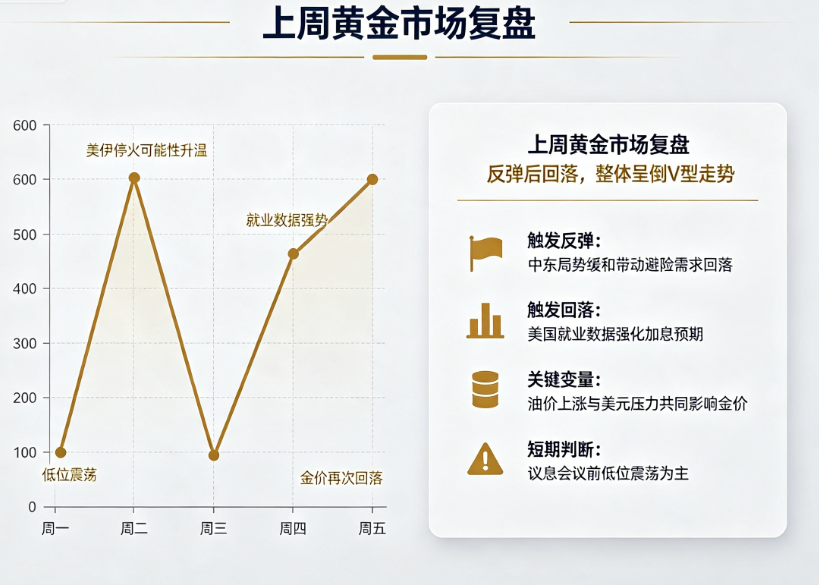
However, financial attributes remain the core factor suppressing gold prices. Even with Middle East uncertainties, as long as US economic data does not show sustained weakness, market expectations for Fed rate hikes will not notably cool, and gold's financial attribute will continue to weigh on prices.
Focus shifts to Fed: re-evaluating the rate path
Short-term market focus has gradually shifted from geopolitical events to the Fed's meeting this week and the policy stance of Chair Walsh. The market will reassess whether the future rate path shows new changes. Before the meeting results are released, gold is expected to remain volatile with limited upside.
If Walsh maintains a hawkish stance, emphasizing determination to curb inflation, gold prices could retest support near $3,900. Conversely, if Walsh softens his hawkish tone and stresses data-dependent policy, the market may correct excessive rate hike expectations, giving gold a chance for a repair rally.
Notably, the Fed's policy direction is not isolated from the global macro environment. The European Central Bank (ECB) held its meeting last week, keeping the deposit facility rate unchanged at 2.25%, in line with expectations. The statement said euro area inflation fell to 2.8% in June; energy prices remain significantly above pre-conflict levels but close to staff projections. Growth risks are tilted to the downside, inflation risks to the upside. Policy continues to be "data-dependent, meeting-by-meeting assessment," without pre-committing to a path. This means major central banks are still waiting, and the Fed's actions will be leading.
Macroeconomic dynamics: services PMI rebound supports economic confidence
July services PMIs for the US, Europe, and the UK generally rebounded, indicating improved services expectations in developed Western economies. Specifically:
- Manufacturing PMI: The US and Japan fell 0.1 from June to 53.8 and 54.7, respectively, still in high prosperity. The euro area and UK rose 0.6 and 0.3 to 52.0 and 52.8, a notable improvement.
- Services PMI: Except for a slight decline in Japan, the US, euro area, and UK rose 2.4, 2.2, and 3.0 to 53.6, 51.6, and 51.8, respectively.
These data show that despite a slowdown in global growth momentum, services sector resilience still supports the economy. For the Fed, if employment and services remain strong, rate hike pressure will not fade, which is a medium-term bearish factor for gold.
China's gold demand rapidly heats up
On the supply side, China's gold demand is heating up significantly. June gold imports reached 173 tons, the highest since March 2024, and grew for the third consecutive month. Cumulative imports in the first half of 2026 were about 820 tons, doubling year-on-year. This shows sharply increased interest from Chinese investors and consumers, possibly related to yuan exchange rate fluctuations and global uncertainty. As the world's largest gold consumer, China's demand recovery provides some floor support but is not enough to reverse the short-term downtrend dominated by financial attributes.
Risk warnings and outlook
Recent gold volatility is high. Investing in gold funds requires full risk awareness and prudent decisions based on personal risk tolerance. Investors should continue to monitor global macroeconomic trends, central bank gold purchases, and relevant policy developments. If the Fed unexpectedly signals dovishness, gold may see a rebound; conversely, if the hawkish stance persists, support near $3,900 will be tested.
Conclusion
In summary, last week gold returned to a consolidative pattern after a weak rebound. Short-term disruptions from the Middle East did not change the downward pressure driven by financial attributes. This week's Fed meeting will be the core variable; investors should closely watch Chair Walsh's policy stance. Until the rate path becomes clear, gold is likely to fluctuate between $3,900 and $4,100. In the medium to long term, the battle between bulls and bears will still revolve around economic data and Fed policy expectations. Investors should remain cautious and adapt flexibly to market changes.

