Okay, as a professional content creator, I will write a professional, in-depth, and well-structured article based on the reference content and images you provided.
Global Gold Market Outlook: Safe-Haven Value Reshaping, Diversified Demand Driving New Trends
In a world of profound changes not seen in a century, with deep shifts in the global economic landscape and endless geopolitical risks, gold—a unique asset with both financial and commodity attributes—is experiencing a re-emergence of its financial properties and value reshaping. Recently, after a strong rally, gold prices have seen volatile corrections, sparking widespread market discussion. However, multiple industry experts and authoritative institutions believe that gold's core status as a major global allocation asset remains unshaken. The high-risk environment and potential interest rate trends will provide solid upward support for gold prices.
Gold's Financial Attributes Highlighted: The Ballast of Global Allocation
On July 16, Mr. An Kai, CEO of the Americas and Global Head of Research at the World Gold Council, clearly stated in his Global Gold Market Outlook presentation that while gold prices have recently experienced volatile corrections, this is a normal technical adjustment after a rapid price surge and a phased correction amid multiple factors. The current gold price volatility is mainly influenced by a complex mix of factors, including repeated geopolitical sentiment shifts, the strengthening and weakening of the US dollar, adjustments in interest rate policy expectations for major economies, and fund diversion from global equity markets.
Specifically, the significant increase in uncertainty risks from the global geopolitical landscape has directly led to phased, pulse-like fluctuations in gold's safe-haven demand, causing short-term tug-of-war between spot and futures markets. Meanwhile, the strength or weakness of the US dollar has always been a core variable affecting gold prices. The significant depreciation of the US dollar at the beginning of the year was a key driver of the sharp rise in gold prices; the subsequent recovery and rebound of the dollar became an important bearish factor for the price correction. In addition, the monetary policy paths of major central banks in Europe and the Americas directly impact the opportunity cost of holding this zero-yield asset, thereby guiding global fund flows and allocation pace. Currently, the strong rally in U.S. stock markets has drawn substantial funds from alternative asset classes into equity markets, creating a noticeable diversion effect on the gold market and further exacerbating short-term gold price volatility.
However, An Kai emphasized that based on global market performance, gold is no longer merely an asset swayed by European and American markets or Fed policy. Its pricing logic is increasingly being profoundly influenced by Asian market demand, the reserve policies of emerging economy central banks, and changes in the global inflation structure. Gold's position as a global asset is becoming increasingly solid.
Analysis of Four Driving Factors: Diverse Support for Gold Prices in the Second Half of the Year
Regarding gold market performance in the second half of the year, An Kai, based on the World Gold Council's analytical framework, conducted a deep dive from four dimensions: economic expansion, risk and uncertainty, opportunity cost, and momentum.
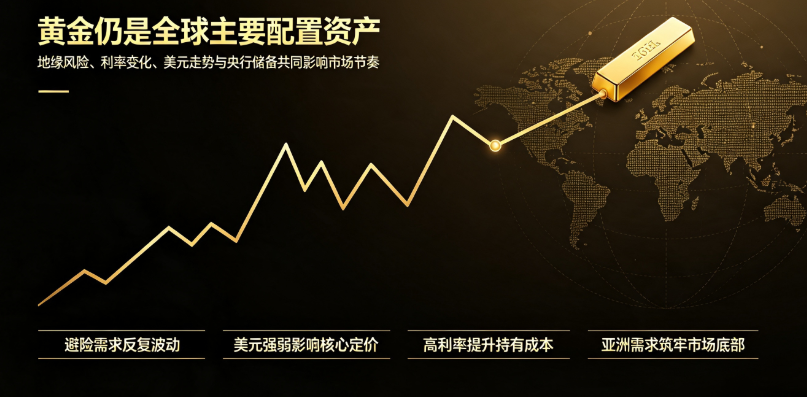 Figure note: The relationship between global economic growth and gold consumption, investment, and industrial demand shows a high positive correlation.
From the economic expansion dimension, global economic growth is highly positively correlated with gold consumption, investment, and industrial demand. With the rapid development of emerging tech industries like artificial intelligence, demand for gold in technology applications is steadily growing, becoming an incremental source of gold demand. Diverse demand from consumption, investment, and industrial sectors provides important bottom support for future gold price trends.
From the risk and uncertainty dimension, market safe-haven demand is a core catalyst driving short-term gold price increases. When global geopolitical risks, macroeconomic volatility, or policy uncertainty rise, market risk aversion intensifies, directly leading to explosive growth in gold allocation demand. Conversely, if market risk sentiment recovers, gold's investment demand will contract in phases. Currently, the complexity of global geopolitical gaming suggests that safe-haven demand will be an unignorable driver in the second half of the year.
From the opportunity cost dimension, the current high-interest-rate environment in Europe and the Americas significantly increases the holding cost of zero-yield assets like gold. However, in Asian markets, especially China and India, interest rates are relatively low, making the opportunity cost for investors holding gold much lower than in Europe and the Americas. This structural interest rate advantage makes gold investment and consumption willingness in Asian markets persistently higher than in Europe and the Americas, forming a solid force supporting global gold prices.
From the demand structure and momentum dimensions, gold shows unique resilience. Its diversified demand composition—including consumption, investment, and central bank reserves—jointly solidifies the bottom for gold prices. China and India, as the world's top two gold consumer markets, contribute approximately 900–1000 tons and 800 tons of demand annually, respectively, dominating the global consumption landscape and serving as indispensable core factors for analyzing gold price trends.
Additionally, the allocation trend of global central banks acts as a "ballast" affecting gold's long-term trajectory. Over the past 15 years, global central banks have consistently been net buyers of gold. The World Gold Council's 2026 Central Bank Gold Reserve Survey shows that 89% of respondent reserve managers expect global central bank gold reserves to continue increasing over the next 12 months, while 74% of respondent central banks anticipate a decline in the US dollar's share of global reserves over the next five years. The strong demand from emerging market central banks to diversify reserve allocations will continue to support gold's long-term outlook.
Macro Events and Market Evolution: Impact of the U.S. Midterm Elections
Regarding the U.S. midterm elections, which the market is closely watching, An Kai analyzed that while the U.S. midterm elections in November this year will not directly determine short-term gold price trends, they will profoundly impact the direction of global macroeconomic policies and market investor sentiment. Uncertainty surrounding fiscal, trade, and industrial policies brought by the elections may drive a phased increase in market safe-haven demand, thereby boosting gold allocation demand. This presents important short-term trading opportunities for the gold market.
Conclusion: The "New Normal" of Gold and Long-Term Allocation Value
In summary, gold is entering a new phase driven by multiple factors, with a more diversified demand structure and more complex pricing logic. In the short term, gold prices will continue to be influenced by variables such as geopolitics, interest rate expectations, and stock market performance, resulting in volatile patterns. However, in the long term, amid the combined effects of a high-risk environment, sustained central bank gold purchases, consumption resilience in emerging economies, and growing gold demand from emerging industries like AI, gold's strategic allocation value as a global asset for hedging against uncertainty and diversifying portfolio risk will become increasingly prominent. For investors, gold is no longer just a safe-haven tool; it has become an indispensable cornerstone for long-term allocation in an era of global monetary system restructuring and heightened asset price volatility.

